1In brief
A script invented by one man, Sequoyah, who could not read.
Type: Syllabary — Each sign stands for a whole syllable. Understand types of scripts.
2History
Sequoyah, a Cherokee who spoke no English and could read no language, was fascinated by the “talking leaves” of white settlers. After years of work, in 1821 he presented a syllabary of 85 signs, one for each syllable of his language.
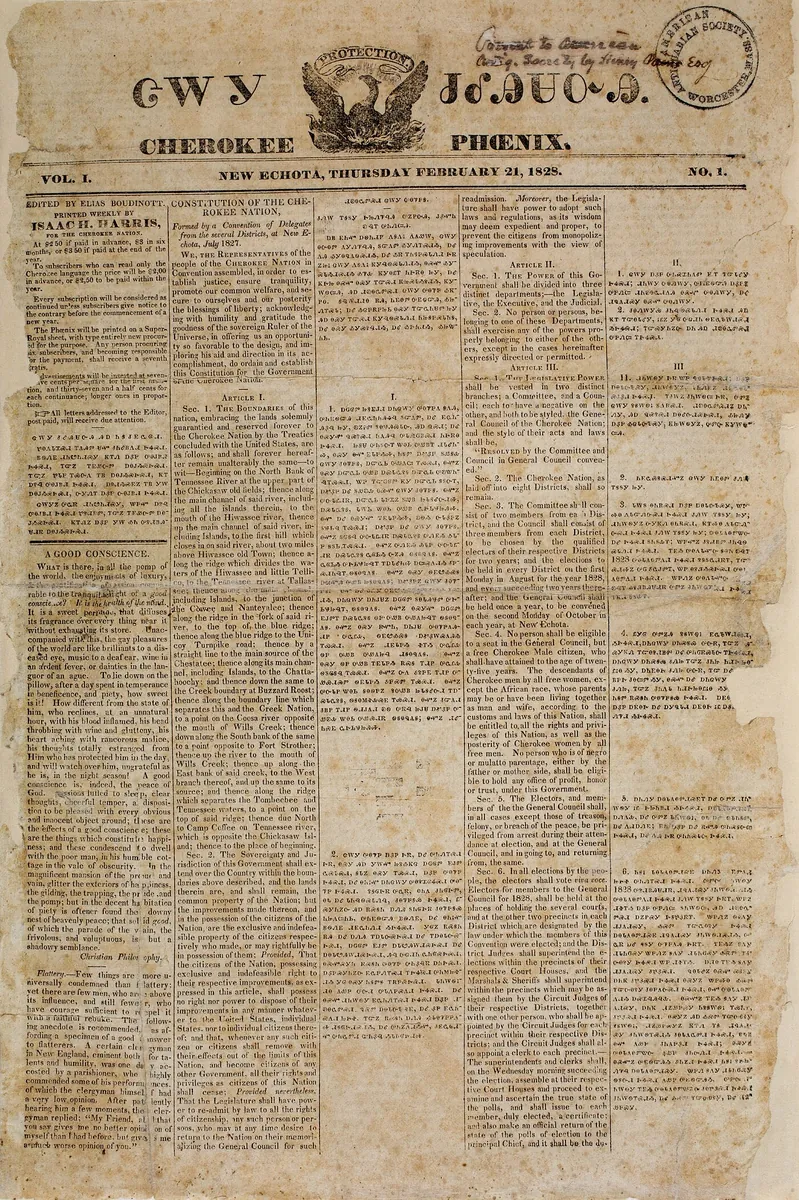
Its success was astonishing: within a few years a large share of the Cherokee could read and write. From 1828 a bilingual newspaper appeared, the Cherokee Phoenix. Some letters look like Latin, Greek or Cyrillic letters, but they are read quite differently: Ꮃ reads “la”, Ꭱ reads “e”.
3A word to see
4For real
5Lineage
This script has no known ancestor among the scripts shown here: it was invented locally, or its origins are still debated.
6Did you know?
- It is one of the very few known cases where a single person invented a complete script without first being able to read.
- The syllabary is taught today in immersion schools in Oklahoma and North Carolina.